Janesville's First High School - Historic Marker Dedication July 4, 2010


Janesville's first high school opened to students in May 1859 and was located at Third (now Holmes) Street and Wisconsin in what is now Jefferson Park. A marker will be dedicated during a neighborhood ceremony at 9:30 am on Sunday, July 4 in Jefferson Park. When the 'new' high school opened in 1895, the old high school was renamed Jefferson School and served elementary grades until it was razed in 1947 to make way for the current neighborhood park.


This photo is in the book 'Art Work of Rock County' by W.H. Parish Publishing Co., copyright 1893.


View this book and more Rock County history online at Janesville's Past

This lithograph of the building appears in the 'Combination Atlas of Rock County' from 1873:

(Click image to enlarge)


Some Janesville School History:

May, 1859 High School opens - located at Third (now Holmes) and Wisconsin

1895 - 1922 Janesville High School located on High Street

1923-1955 Janesville High School located on Main Street

1955 New Janesville Senior High School opened on Randall Avenue

Main Street school became Marshall Junior High

1962 Franklin Junior High opened on Crosby Avenue

1967-1968 George S. Parker High School opened on Mineral Point Avenue

1967-1968 Janesville Senior High School renamed Joseph A. Craig High School

1971 Edison Junior High School opened on Chatham Street

1997 New Marshall Middle School opened on Pontiac Drive


The Janesville Schools Annual Report for the School Year Ending June 30, 1895, includes this description of the first Janesville High School, which opened in 1859. It describes the controversy surrounding the removal of remains from the old village cemetery prior to building the school. Click image to enlarge:


The story of the new school continues on the next page:


Learn more of Janesville's local history through Hedberg Public Library or contact the Reference Desk for assistance 608-758-6581 or referencedesk@hedbergpubliclibrary.org.

Posted 6/25/2010 by sb


"March Madness" from Janesville's Past

Basketball "March Madness" took center stage in Janesville, Wisconsin over the years....

On March 29, 1913, Janesville High School boys beat LaCrosse 38-24 to win the state basetball championship in Appleton.

On March 20, 1971, the Parker High School boys defeated Milwaukee Rufus King, 79-68, to win the Wisconsin Interscholastic Athletic Association (WIAA) state high school boys basketball championship.


Bob Morgan coached the '71 team, featuring two all-conference players, Bob Luchsinger Jr. and Dick Meier. Parker players set state records by hitting all 23 of their free throws and shot 62.2 percent on field goal attempts. All three are members of the Janesville Sports Hall of Fame.


You can view the commemorative booklet from that championship season in the Janesville Room at Hedberg Public Library, 316 S. Main Street, Janesville, Wisconsin.

According to the WIAA, 1971 was the last year of a single division in the state boys basketball tournament. The 1934 tournament was the first that was broken into divisions. In 1940, it went back to a single division. In 1972, it returned to a divisional format and has remained that way.

In 1993, Parker High School girls won the state championship after trying three times before. Tom Klawitter was the coach, and Jennah Burkholder was named tournament MVP.

Learn more about it at Hedberg Public Library!
Contact the Reference Desk for assistance at referencedesk@hedbergpubliclibrary.org or 608-758-6581.

Source: Century of Stories, George S. Parker High School yearbooks, 1971 commemorative booklet.

--posted by SB on 03/27/2010
GM & UAW: In Their Own Words: A collection of interviews with General Motors employees, union members and others involved in Janesville's manufacturing history.


Eugene Osmond is one of twelve interviews now available online. You can read or listen to his words as told over thirty years ago in Janesville!

Born in Janesville in 1908 and one of 14 children, Eugene worked for Janesville Sand and Gravel at age 13 before working 40 years at the Chevrolet plant. He participated in the 1937 sit-down strike and was one of the earliest members of the United Auto Workers and served as a trustee.

Others interviewed: Lou Adkins, Don Dooley, Ralph Hilkin, Harry Johnson, James (Jack) V. Johnson, Gerald Litney, Hugo Preuss, Glenn Swinbank, John Wesley Van Horn, and James Wells.

To read or listen to all interviews, visit the Hedberg Public Library web page: GM & UAW: In Their Own Words.

Contact a Reference Librarian by email referencedesk@hedbergpubliclibrary or phone 608-758-6581 for more information.

--sb
2/17/2010


"It Wouldn't Feed Snipe": Irish Immigrants in Janesville


If you had to guess where Irish ancestry ranked among Wisconsin citizens, what would you say?

Perhaps fourth--after Germans, Norwegians, and Swedes or Finns? No! In the 2000 census, 11% of Wisconsin citiziens identified themselves as Irish, making Irish ancestry second only to German in the state.


A Canadian man has written a new history of an Irish immigrant family that once lived in Janesville. Intrigued by several mysteries about his maternal grandparents' Irish roots, Thomas Baxter researched and wrote about John Regan and Mary Sheehan Regan in his 2009 book, It Wouldn’t Feed Snipe. Some of the author’s questions were:

--What made his grandfather decide to leave Ireland in 1907, long after the Potato Famine?

--What brought him (and his future wife, also an Irish immigrant) to Janesville in particular?

--Why did his maternal grandmother leave Ireland without saying goodbye to her family and fail to resume contact with them once she returned?

--Why did the family return permanently to Ireland in 1924?

--What kind of people were the grandparents he had never known?


The author has done considerable research. He discovered the Janesville places where his grandparents lived (406 and 496 W. Holmes; 218 S. Park St.) and where his grandfather worked (the Janesville Fire Department, the railroad, and as a stockman at the School for the Blind, among others), and provides a useful map of where his grandparents and their fellow Irish immigrants lived in Janesville’s Fourth Ward. He found out a lot about his grandmother’s difficult personality and ambitions, and shows the stark contrast between life in the U.S. and life in Ireland in the 1920s. Ultimately, however, he is unable to answer all the questions that prompted him to write the book, and what he does uncover about his grandmother’s personality is not very flattering. But his firmest conclusion—why the family returned to Ireland—appears to be related to the significance of owning land in Ireland. When the author’s grandfather was finally able to own the family farm in Ireland—even though its quality was so poor “it wouldn’t feed snipe”—the lure to return and to try to operate it proved irresistible.


One of the most interesting aspects of this family's story is how the Regans embodied many of the characteristics of other Irish immigrants described in The Irish in Wisconsin, by David G. Holmes (Wisconsin Historical Society Press, 2004). Like other people from Ireland, the Regan family passed on their Irish land only to one son, the eldest. Consequently, if one were a younger son--as John Regan was--one's career choices in Ireland were limited. There were few thriving businesses in the rural areas and virtually no free land to buy or rent. Such people believed that their only opportunity for a better life lay overseas.


Another characteristic of Irish immigrants is that, unlike other ethnic groups, women emigrated in roughly the same numbers that men did, and--another uniquely Irish characteristic--many of these women were single. The author's grandmother--Mary Sheehan--actually left Ireland on her own, without telling her family that she was leaving. And, like her future husband and most other Irish immigrants, she settled on Janesville as her ultimate destination when she met other Irish people who had already immigrated to the town or who were actually heading to that town and who encouraged her to join her there.


Author Tomas Baxter makes the point that Irish women in Wisconsin had a degree of independence unthinkable in Ireland, a situation that made life particularly difficult for Mary Sheehan Regan when she returned to her native country and her relatives, married and with three children, 17 years after leaving it.


The major difference between the author's grandparents and other Irish immigrants is
that, drawn back by the fact that his family's Irish farm had finally become available to him, John Regan and his wife returned to Ireland permanently, putting them among the fewer than 10% of Irish immigrants who went home for good.


A short book printed on glossy paper richly illustrated with family photos, maps, official documents, and family letters, It Wouldn’t Feed Snipe is a memoir about Irish immigrants who came to the United States but chose not to stay. You can read it at Hedberg Public Library.


--LG

Janesville High School Construction Photos 1922-23

In September 2009 the Janesville Performing Arts Center celebrated its 5th anniversary. JPAC is located on Main Street next to our library, in what was the original 'new' Janesville High School, which opened in 1923. J.P. Cullen of Janesville did the original construction. Here's how it appeared then. The auditorium is known for its superior acoustics. Singer Tony Bennett graced the stage for JPAC's grand opening, and marveled at the sound - as did the audience!


The label in the lower right includes "Vanryn & DeGelleke, Architects"


This next photograph is dated April 7, 1922 with
'J.P. Cullen & Son Contr's., Janesville, Wisc.'
written on the right side.


Another view from April 7, 1922, with the sign 'Marquette Cement Furnished on this Job by Fifield Lumber Co.'.


A rear view of the new building, from the other side of Rock River:


The view from the Racine Street bridge.


This new building was the third Janesville High School, from 1923 to 1955, when a new school opened on Randall Avenue. This building became Marshall Junior High. Note: the street is brick in 1923!


--posted by sb

From Madison to Janesville with a stop in Union, 1864


From Madison to Janesville with a stop in Union, 1864


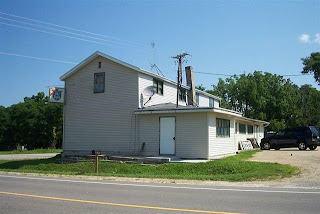
Union Tavern, August 2009


The Janesville Gazette recently noted the celebration of Paul Milz’s 50 years of owning the Union Tavern in the tiny village of Union, Wisconsin (August 9, 2009, 2A) . Because I pass this tavern regularly on my commute to Hedberg Public Library, the article grabbed my attention.


According to Evansville historian Ruth Ann Montgomery, early Union settler “Samuel Lewis operated a hotel (sometimes called a tavern)” and an informal post office shortly after he and his family arrived in Union in September 1839. Very soon afterward, Union became the half-way point between Janesville and Madison on what is now Highway 14, and stagecoach drivers always stopped at the “Half-Way House” to change horses and drivers. By 1858, she says, the village of Union was large enough to sustain two dry good stores, one hotel or tavern, one physician, 1 district school with 45 pupils, a Baptist minister, 1 blacksmith shop, 1 tailor’s shop, a shoemaker’s shop, 1 cabinet shop, 3 joiners, 1 painter, 1 wagon maker and 2 masons. In fact, for many years, Union provided the only grocery store in the greater Evansville region (Evansville Review, February 27, 1975). Union seemed likely to outpace Evansville in population until the early 1860s when the railroad bypassed the village in favor of Evansville, and Union’s population started to decline.

Interestingly enough, in 1864 another Madison resident, Sarah Hobbins (Mrs. Joseph Hobbins, Jr.) made the same trip I regularly make from Madison to Janesville. Unlike my regular commute by car, this was a once-in-a-decade summer outing for her. Disdaining the railroad available at that time, she and her husband—“the Dr.”-- made the journey by horse and carriage, stopping in Union village to eat lunch at a “wayside inn”—possibly the Union Tavern itself! Her lunch is a contrast with my usual "dashboard dining" on a Veggie Delite sandwich from Subway. She described her journey in a letter to her mother:

"This is the first journey from home we have taken for pleasure alone during the ten years we have been in Madison, but the Dr. thought we both required a change, so on a fine June morning with little preparation except some sandwiches and some fine strawberries from our garden which Josephine gathered for us, we started in a south-westerly direction to Janesville about 40 miles from here. The most novel and attractive feature of the scenery through which we passed were the wide rolling prairies for miles and miles which reminded me of the ocean. The rich grass waving on them is very beautiful. Then there are vast tracts richly cultivated, where wheat and different varieties of grain were grown and looked most promising and luxuriant. We also passed many pretty residences. Again we seemed to be in regions quite wild, sometimes losing our way, for it is very difficult in a prairie region to select the right road, but the Dr. is very clever at this, seldom making a mistake.

“About one o'clock we dined at a place called UNION. It was one of the wayside Inns where people are glad to put up where they can find refreshments of some kind for want of a better. The nicely broiled salt pork, fresh eggs, pies, cakes, doughnuts, and cheese was quite a tempting repast. The Dr. made his dinner of an egg and potato [and] cup of tea, and luckily I thought of my strawberries which the landlady smothered in cream…”

“In the evening we reached Janesville where we had as excellent accommodations for the night as we should find at the Astor House in New York. Janesville is very pleasantly situated on the Rock River, being mostly built on rising ground, about the same size as Madison. The Asylum for the Blind is here with some of the finest educational buildings in Wisconsin and some very beautiful residences.” (Mrs. Hobbins’ letter is from Three Hundred Years American: The Epic of a Family, by Alice F. and Bettina Jackson (State Historical Society of Wisconsin, 1951, pp. 280-281.)

I love the description of the Hobbinses’ carriage ride through the prairie. Though it would be difficult in 2009 to lose one’s way on Highway 14, the rural character of its landscape—with corn and soybean crops replacing the wheat that once grew there--is still just as charming and peaceful as it was in 1864.


And I am longing to know: was it at the Union Tavern where the Hobbinses ate their lunch? Current Union Tavern owner Paul Milz stated that the original part of the tavern was built in 1846 and once served as a stagecoach stop, livery stable, and grocery store. He doesn’t mention its being a hotel or wayside inn. But as you can see in Montgomery’s description above, the lone tavern in the village in 1858 appears to have doubled as a hotel—a common occurrence on the frontier. Though Montgomery mentions that, at a later time, Union had a couple of hotels, one known—significantly enough--as the “Old Tavern” which was torn down in 1902, and another, known as the “Union Inn,” which was destroyed in a fire in 1934, both might have been built after the Hobbinses’s visit.


We’ll probably never know in which building the Hobbinses ate their salt pork, eggs, pies, and strawberries, but I like to think that it might have been Paul Milz’s Union Tavern that serves as a landmark on my own travels to Janesville.
--LG

Fair History in Rock County

Did you know that Janesville was the site of the very first Wisconsin State Fair on October 1-2, 1851? It was held on the banks of the Rock River and sponsored by the newly-formed State Agricultural Society. There were 461 total entries with a profit of $85.45. Popular features include a 200-pound squash and a quarter-acre plowing match.

(Click photograph to enlarge text)

The fairgrounds contained 6 acres and about 10,000 people attended. The fair was held just east of Upper Courthouse Park, now a residential area in the Courthouse Hill Historic District.

You can read more about it at Hedberg Public Library.
Our Local History Database contains many references
to the Wisconsin State Fair in Janesville here.
Or, email a Reference Librarian referencedesk@hedbergpubliclibrary.org or call us during open hours at 608-758-6581.

--SB